
The Emotional Side of Limited-Time Offers
Article Sidebar
Main Article Content
Abstract
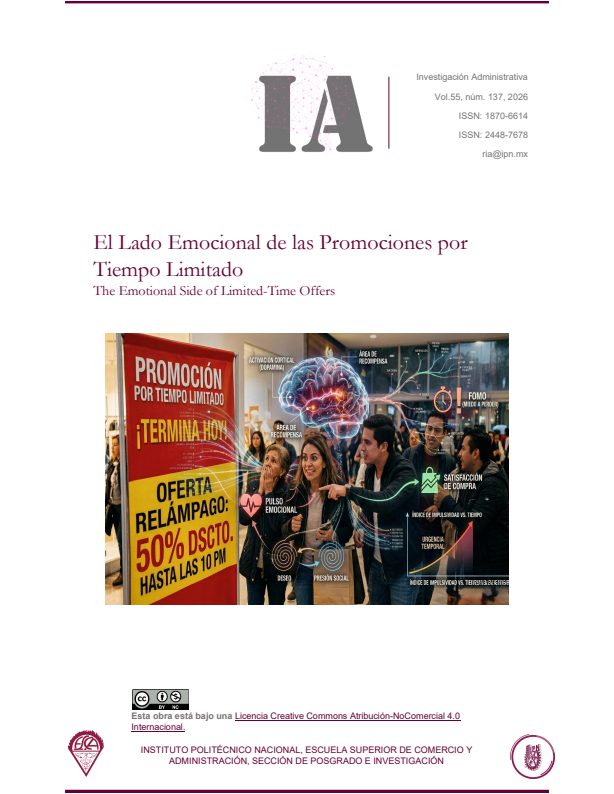
The objective of this study was to analyze the impact of limited-time offers (LTOs) on consumer purchase intention, considering the mediating effect of psychological reactance and perceived scarcity. The method consisted of two quantitative experimental studies: a structural model (n = 368) and a neuromarketing analysis (n = 40). Results show that LTOs increase purchase intention, but reactance acts as a stronger negative mediator than scarcity. The originality of the study lies in combining emotional and visual analyses to explain this phenomenon. Among the main findings, the desire for possession intensifies psychological reactance. The principal limitation is the application to a single product category. It is concluded that the effectiveness of LTOs depends on specific psychological factors and the type of product under consideration.
Article Details

This work is licensed under a Creative Commons Attribution-NonCommercial 4.0 International License.
References
Abdelnour, A., Babbitz, T., & Moss, S. (2020). Pricing through the pandemic: Getting ready for recovery. McKinsey & Company, available at: https://www.mckinsey.com/business-functions/marketing-and-sales/our-insights/pricing-through-the-pandemic-getting-ready-for-recovery
Ali, F., Maqsood, H., & Janjua, Q. (2025). Psychological Triggers in Online Shopping: The Influence of Scarcity, Urgency, and Personalization on Consumer Buying Behavior. The Critical Review of Social Sciences Studies, 3(2), 269-289. https://doi.org/10.59075/cxyapm95
Alkufahy, A. M., Al-Alshare, F., Qawasmeh, F. M., Aljawarneh, N. M., & Almaslmani, R. (2023). The mediating role of the perceived value on the relationships between customer satisfaction, customer loyalty and e-marketing. International Journal of Data & Network Science, 7(2). doi:10.5267/j.ijdns.2022.12.022
Boden, J., Maier, E. and Wilken, R. (2020), “The effect of credit card versus mobile payment on convenience and consumers’ willingness to pay”, Journal of Retailing and Consumer Services, Vol. 52, pp. 1-10, doi: 10.1016/j.jretconser.2019.101910.
Bozorgkhou, H., & Alimohammadirokni, M. (2022). Studying and investigating the impact of marketing mix factors on e-purchase via smart phones (case study: Digikala corporation). Nexo Scientific Journal, 35(04), 992-1003.
Brinson, N. H., Eastin, M. S., and Cicchirillo, V. J. (2018). “Reactance to personalization: understanding the drivers behind the growth of ad blocking.” Journal of Interactive Advertising, Vol. 18 No. 2, pp.136–147.
Cakranegara, P.A., Kurniadi, W., Sampe, F., Pangemanan, J. and Yusuf, M. (2022), “The impact of goods product pricing strategies on consumer purchasing power: a review of the literature”, Jurnal Ekonomi, Vol. 11 No. 03, p. 2022, available at: http://ejournal.seaninstitute.or.id/index.php/Ekonom
Carlson, J., Rosenberger, P.J., III and Rahman, M.M. (2015), “Cultivating group-oriented travel behaviour to major events: assessing the importance of customer-perceived value, enduring event involvement and attitude towards the host destination”, Journal of Marketing Management, Vol. 31 No. 9, pp. 1065-1089, doi: 10.1080/0267257x.2015.1035309.
Chan, E. Y. (2024). Consumer behavior in practice. Springer Books. https://doi.org/10.1007/978-3-031-50947-6
Chang, H.H. and Wang, H. (2011), “The moderating effect of customer perceived value on online shopping behaviour”, Online Information Review, Vol. 35 No. 3, pp. 333-359, doi: 10.1108/ 14684521111151414.
Chen, Z. and Dubinsky, A.J. (2003), “A Conceptual model of perceived customer value in e-commerce: a preliminary investigation”, Psychology and Marketing, Vol. 20 April, pp. 323-347, doi: 10.1002/ mar.10076.
Chou, H. Y. (2019). “Units of time do matter: How countdown time units affect consumers’ intentions to participate in group-buying offers.” Electronic
De Toni, D., Pompermayer, R., Lazzari, F. and Milan, G.S. (2022), “The symbolic value of wine, moderating and mediating factors and their relationship to consumer purchase intention”, International Journal of Wine Business Research, Vol. 34 No. 2, pp. 190-211, doi: 10.1108/ijwbr01-2021-0006.
Edwards, S. M., Li, H., and Lee, J.-H. (2002). “Forced exposure and psychological reactance: antecedents and consequences of the perceived intrusiveness of pop-up ads.” In Journal of Advertising: Vol. XXXI.
Ercan, U., Büyükdağ, N., Kasalak, M. A., & Ozekicioglu, H. (2025). Price Promotion Effect on Purchase Behavior Under the Time Limit/Pressure. SAGE Open, 15(1), 21582440251327270. https://doi.org/10.1177/21582440251327270
Gong, Z., & Huang, J. (2024). Limited Time Offer and Consumer Search. Management Science. https://doi.org/10.1287/mnsc.2022.00445.
Gorji, M. and Siami, S. (2020), “How sales promotion display affects customer shopping intentions in retails”, International Journal of Retail and Distribution Management, Vol. 48 No. 12, pp. 1337-1355, doi: 10.1108/ijrdm-12-2019-0407.
Grandi, B. and Cardinali, M.G. (2022), “Colours and price offers: how different price communications can affect sales and customers’ perceptions”, Journal of Retailing and Consumer Services, Vol. 68 March, pp. 1-12, doi: 10.1016/j.jretconser.2022.103073.
Grewal, D., Monroe, K. B., & Krishnan, R. (1998). The effects of price-comparison advertising on buyers’ perceptions of acquisition value. Journal of Marketing, 62(2), 46–59.
Guzmán Martínez, F. J. (2026). Influencer marketing and micro-influencers in internationalization strategies. In S. Teixeira, J. Remondes, & S. Zelaya (Eds.), Marketing Strategies for the Internationalization of Businesses and Brands (pp. 365–418). IGI Global. https://doi.org/10.4018/979-8-3373-1787-8.ch012
Guzmán Martínez, F. J., Castro Calvo, A. V., & González Salgado, L. M. (2025). De la confianza a la compra: experiencia omnicanal, confianza de marca e intención de compra. Investigación administrativa, 54(135).
Guzmán Martínez, F. J., & Orozco Gómez, M. M. (2024). The emotional side of price: reference price as a decision maker in consumer purchase. International Journal of Retail & Distribution Management, 52(7/8), 771–785. https://doi.org/10.1108/IJRDM-08-2023-0504
Hao, S., & Huang, L. (2025). The persuasive effects of scarcity messages on impulsive buying in live-streaming e-commerce: the moderating role of time scarcity. Asia Pacific Journal of Marketing and Logistics, 37(2), 441-459. https://doi.org/10.1108/APJML-03-2024-0269
Hmurovic, J., Lamberton, C., & Goldsmith, K. (2022). Examining the Efficacy of Time Scarcity Marketing Promotions in Online Retail. Journal of Marketing Research, 60(2), 299-328. https://doi.org/10.1177/00222437221118856
Ismajli, A., Ziberi, B., & Metushi, A. (2022). The impact of neuromarketing on consumer behaviour. Corporate Governance and Organizational Behavior Review, 6(2), 95-103. https://doi.org/10.22495/cgobrv6i2p9
Jeong, H., Bhatt, S., Ye, H., Zhang, J. and Suri, R. (2022), “When and whom should retailers offer price reductions in times of crisis?”, International Journal of Retail and Distribution Management, Vol. 50 No. 6, pp. 744-759, doi: 10.1108/ijrdm-08-2020-0293
Jindal, P. (2022), “Perceived versus negotiated discounts: the role of advertised reference prices in price negotiations”, Journal of Marketing Research, Vol. 59 No. 3, pp. 578-599, doi: 10.1177/ 00222437211034443
Kamariah Binti, N., Wahid, A., Binti, W. R., and Husain, W. (2023). “The limited-edition or what they call ‘scarcity marketing’: propaganda or a promotional strategy through ‘FOMO’ thinking.” IIUM Journal of Case Studies in Management, Vol. 14 No. 2, pp.49–52.
Kaswengi, J., Diallo, M.F., Akrout, H. and Valette-Florence, P. (2020), “Choosing high-equity cosmetic brands in bad macroeconomic conditions: evidence from panel data”, International Journal of Retail and Distribution Management, Vol. 48 No. 4, pp. 305-325, doi: 10.1108/ijrdm-01-2019-0003
Khetarpal, M., & Singh, S. (2024). “Limited time offer”: Impact of time scarcity messages on consumer’s impulse purchase. Journal of Promotion Management, 30(2), 282-301. https://doi.org/10.1080/10496491.2023.2253228
Kienzler, M. (2020). Value-based pricing and cognitive biases: An overview. Industrial Marketing Management, 68, 86–94. https://doi.org/10.1016/j.indmarman.2017.09.028
Kim, J., Jhang, J., Kim, S. and Stylidis, D. (2023), “The impact of price preciseness, price reduction, and lay rationalism on travelers’ perceptions of deal attractiveness, purchase intention, and choice”, Journal of Travel Research, Vol. 62 No. 7, pp. 1550-1568, doi: 10.1177/00472875221129255.
Kim, J., Lee, Y., and Kim, M. L. (2020). “Investigating ‘fear of missing out’ (FOMO) as an extrinsic motive affecting sport event consumer’s behavioral intention and FOMO-driven consumption’s influence on intrinsic rewards, extrinsic rewards, and consumer satisfaction.” PLoS ONE, Vol. 15 No. 12 December.
Konuk, F.A. (2021), “The moderating impact of taste award on the interplay between perceived taste, perceived quality and brand trust”, Journal of Retailing and Consumer Services, Vol. 63 July, pp. 1-8, doi: 10.1016/j.jretconser.2021.102698.
Lee, S. Y. (2013). The effect of scarcity on product evaluation. Library and Archives Canada = Bibliothèque et Archives Canada.
Liang, C. C., & Lin, Y. W. (2023). Online promotion effects under time limitation-A study of survey and physiological signals. Decision support systems, 170, 113963. https://doi.org/10.1016/j.dss.2023.113963
Lynn, M. (1989). “Scarcity effects on value: a quantitative review of the commodity theory literature.” Journal of Economic Psychology.
Misra, L. (2023). Neuromarketing insights into consumer behavior. IUJ Journal of Management, 11(1), 143-163. available at: https://journal.iujharkhand.edu.in/June-2023/Neuromarketing-Insights-Into-Consumer-Behavior.pdf
Mukherjee, A., Lee, S. Y., & Gershoff, A. (2025). Consumer flexibility and the effectiveness of limited time offers: the role of psychological reactance. Journal of Business Research, 200, 115645. https://doi.org/10.1016/j.jbusres.2025.115645
Papavasiliou, A., Smeers, Y., & d’Aertrycke, G. D. M. (2021). Market design considerations for scarcity pricing: A stochastic equilibrium framework. The Energy Journal, 42(5), 195-220. https://doi.org/10.5547/01956574.42.5.apap
Peng, L., Zhang, W., Wang, X., and Liang, S. (2019). “Moderating effects of time pressure on the relationship between perceived value and purchase intention in social e-commerce sales promotion: considering the impact of product involvement.” Information & Management, Vol. 56 No. 2, pp.317–328.
Priester, A., Robbert, T. and Roth, S. (2020), “A special price just for you: effects of personalized dynamic pricing on consumer fairness perceptions”, Journal of Revenue and Pricing Management, Vol. 19 No. 2, pp. 99-112, doi: 10.1057/s41272-019-00224-3.
Sun, Y., Sheng, Y., Yan, S., & Zhang, W. (2023). Pricing strategies in reward-based crowdfunding: Whether to introduce price guarantee?. Transportation Research Part E: Logistics and Transportation Review, 170, 103024. https://doi.org/10.1016/j.tre.2023.103024
Shaddy, F., & Lee, L. (2020). Price promotions cause impatience. Journal of Marketing Research, 57(1), 118-133. https://doi.org/10.1177/0022243719871946
Sharma, N. and Dutta, N. (2023), “Omnichannel retailing: exploring future research avenues in retail marketing and distribution management”, International Journal of Retail and Distribution Management, Vol. 51 No. 7, pp. 894-919, doi: 10.1108/ijrdm-05-2022-0166
Tiemessen, J., Schraffenberger, H., & Acar, G. (2023,April). The time is ticking: The effect of limited time discounts on consumers’ buying behavior and experience. In Extended Abstracts of the 2023 CHI Conference on Human Factors in Computing Systems (pp. 1-11). https://doi.org/10.1145/3544549.3585735
Villanova, A., García, B. and Fernández, C. (2021), “Retailer marketing communications in the digital age: getting the right message to the right shopper at the right time”, Nombre de la Revista, Vol. 45 No. 3, pp. 123-145.
Wu, Y., Xin, L., Li, D., Yu, J., & Guo, J. (2021). How does scarcity promotion lead to impulse purchase in the online market? A field experiment. Information & Management, 58(1), 103283. https://doi.org/10.1016/j.im.2020.103283
Xin, M., Jian, L., Liu, W., & Bao, Y. (2025). Exploring the Effect of Live Streaming Atmospheric Cues on Consumer Impulse Buying: A Flow Experience Perspective. Journal of Theoretical and Applied Electronic Commerce Research, 20(2), 149. https://doi.org/10.3390/jtaer20020149
Zhang, Z., Zhang, Z., & Chen, P. Y. (2021). Early bird versus late owl: an empirical investigation of individual shopping time habit and its effects. Mis Quarterly, 45(1). doi: 10.25300/MISQ/2021/14312